
Horizontal Sleeper Sofa: The Complete Guide to Wide Convertible Sofas
A horizontal sleeper sofa is a wide convertible couch that unfolds or pulls out from side to side rather than front to back. This distinctive mechanism delivers a broader, more spacious sleeping surface without requiring the deep floor footprint of a traditional pull-out couch. For anyone researching convertible furniture, understanding how horizontal sleeper sofas work — and where they excel — is essential before making a purchase.
In this guide, you'll learn exactly what defines a horizontal sleeper sofa, how it compares to vertical pull-out models, which room layouts benefit most, what sizes and price ranges exist, and how to avoid the most common buying mistakes. By the end, you'll have the practical knowledge needed to confidently select the right wide sleeper sofa for your home.
What Exactly Is a Horizontal Sleeper Sofa?
Horizontal Sleeper Sofa — Simple Definition
A horizontal sleeper sofa is a convertible sofa whose sleeping surface extends sideways — parallel to the backrest — instead of pulling straight out toward the viewer. The mattress or cushion platform unfolds laterally, creating a wide, relatively shallow bed. Unlike a standard click-clack sleeper sofa that folds flat in place, a horizontal model may use a side-pull mechanism, a flip-out platform, or a lateral slide-out frame.
This horizontal orientation is the defining characteristic. When you convert the sofa, the sleeping area grows in width rather than in depth. The result is a bed that feels generous side-to-side but does not protrude as far into the room. That single engineering difference changes everything about how the sofa fits into a living space.
Many shoppers confuse horizontal sleeper sofas with wide sleeper sofas or extra-long sleeper sofas. While there is overlap, "horizontal" specifically describes the direction of the conversion mechanism, not just the finished dimensions. A horizontal sleeper sofa can be compact, queen-sized, or even a king sleeper sofa depending on the model.
Lateral Conversion
The sleeping platform extends sideways, keeping the sofa's depth footprint manageable.
Wide Sleep Surface
Because the bed grows widthwise, sleepers enjoy more shoulder and hip room.
Shallow Depth
Ideal for rooms where a traditional pull-out would block traffic flow or hit furniture.
Varied Mechanisms
Side-pull, flip-out, and lateral slide systems all qualify as horizontal designs.
How Does a Horizontal Sleeper Sofa Work?
Understanding the mechanism helps you evaluate quality and predict long-term reliability. Horizontal sleeper sofas typically use one of three conversion systems:
- Side-Pull Platform: The seat cushion and underlying frame slide sideways on metal rails, revealing a flat sleeping surface. This is the most common horizontal design.
- Flip-Out Lateral Mechanism: The seat flips forward and then rotates sideways, creating a wide bed. Often found in modern sleeper sofas with minimalist profiles.
- Lateral Slide-Out Frame: A secondary frame housing the mattress slides out to the side, similar to a drawer. Common in sectional sleeper sofa configurations.
Regardless of the specific design, the sleeper sofa mechanism guide principle is the same: the conversion direction determines the bed's proportions. Horizontal mechanisms prioritize width; vertical pull-outs prioritize length. Neither is inherently better — they simply suit different rooms and sleepers.
One practical advantage of horizontal systems is that they often require less clearance in front of the sofa. A traditional pull-out needs two to three feet of open floor space directly ahead. A horizontal sleeper sofa needs that clearance to the side instead, which can be a decisive factor in narrow living rooms or small apartment sleeper sofa setups.
Horizontal vs. Vertical Sleeper Sofas: Key Differences
Before choosing a horizontal model, it helps to see how it stacks up against the conventional vertical pull-out. The table below summarizes the most important distinctions.
| Feature | Horizontal Sleeper Sofa | Vertical Pull-Out Sofa |
|---|---|---|
| Conversion Direction | Extends sideways (parallel to backrest) | Extends forward (perpendicular to backrest) |
| Bed Proportions | Wider and shallower | Narrower and deeper |
| Floor Clearance Needed | To the side of the sofa | Directly in front of the sofa |
| Best For | Narrow rooms, tight traffic paths, wide sleepers | Rooms with open floor space in front |
| Mattress Type | Often foam or memory foam sleeper sofa platforms | Typically innerspring or foam fold-out mattresses |
| Typical Price Range | $800–$2,500 | $600–$3,000 |
| Weight | Generally lighter (fewer moving parts) | Heavier (larger metal frame assemblies) |
The takeaway is straightforward: if your room is long and narrow, or if you cannot sacrifice floor space in front of the sofa, a horizontal design is often the smarter choice. If you prefer a deeper, more traditional bed shape, a vertical pull-out may still be preferable.
Pros and Cons of Horizontal Sleeper Sofas
No furniture category is perfect for every home. Here is an honest look at the advantages and drawbacks you should weigh before buying.
Advantages
- Conserves front-facing floor space, ideal for narrow rooms
- Wider sleeping surface accommodates restless sleepers
- Often lighter and easier to move than vertical pull-outs
- Works well as a small sleeper sofa in apartments
- Fewer large metal components means fewer hinge failures
- Blends naturally into low-profile sleeper sofa designs
Drawbacks
- Sleeping surface may be shorter than a standard bed
- Side clearance required — not ideal for corner placement
- Less common in stores, so fewer options to try in person
- Mattress replacement can be harder to source
- Some budget models compromise on cushion density
- May not suit tall sleepers over 6 feet
If you are tall, pay special attention to the sleeping length. Some horizontal models measure only 70 to 74 inches from head to foot. A 72-inch sleeper sofa or 70-inch sleeper sofa may feel cramped for taller guests. Always verify dimensions before purchasing.
Horizontal Sleeper Sofa Sizes and Price Ranges
Horizontal sleeper sofas come in several size categories. The table below outlines typical dimensions and current market pricing. Prices reflect standard fabric upholstery; leather and high-end sleeper sofa collections command higher figures.
Twin / Compact
Sleep surface: 38" × 72"
$800–$1,400
Full
Sleep surface: 54" × 72"
$1,000–$1,800
Queen
Sleep surface: 60" × 74"
$1,300–$2,200
King / Wide
Sleep surface: 72" × 76"
$1,800–$2,500
These figures represent the current market as of writing. Entry-level models under $1,000 often use lower-density foam and lighter frames. Mid-range models in the $1,300–$1,800 bracket typically offer better cushion support and more durable mechanisms. Premium horizontal sleeper sofas above $2,000 frequently feature linen sleeper sofa or cotton sleeper sofa upholstery with reinforced metal frame sleeper sofas construction.
If you are shopping on a tighter budget, consider a secondhand sleeper sofa buying strategy — horizontal models are less common on the resale market, but when they appear, prices can be 40–60% below retail. Just inspect the mechanism carefully before committing.
Which Room Layouts Suit a Horizontal Sleeper Sofa Best?
The horizontal design shines in specific spatial conditions. Consider these scenarios:
- Narrow Living Rooms: When the distance from the sofa to the opposite wall is limited, a horizontal sleeper avoids blocking the living room traffic flow design.
- Open-Concept Spaces: In apartments where the living area blends into the kitchen or dining zone, a horizontal conversion keeps the bed from intruding into adjacent zones.
- Guest Rooms with Tight Footprints: A full size sleeper sofa for small space often benefits from horizontal mechanics because the bed extends along the wall rather than into the room.
- Sectional Configurations: A L-shaped pull-out sleeper sofa or sectional sleeper sofa with chaise can integrate a horizontal mechanism into one arm, preserving the overall footprint.
- RV and Tiny Home Interiors: A RV sofa sleeper or 72-inch RV sleeper sofa frequently uses horizontal conversion to maximize limited floor area.
One layout caveat: horizontal sleeper sofas need clearance to the side. If your sofa sits in a corner with walls on both ends, a horizontal mechanism may not have room to extend. In that case, a corner sleeper sofa with a vertical pull-out or a flip-out sleeper sofa may be more practical.
For those styling the room after purchase, consider how the wide profile affects your sleeper sofa vignette ideas. A horizontal sofa often pairs well with a long, low console behind it and layered sleeper sofa textile layering to soften the broad silhouette.
Recommended Horizontal Sleeper Sofas
⚠️ AFFILIATE DISCLOSURE: This website contains affiliate links. As an affiliate Associate, we earn from qualifying purchases. If you make a purchase through these links, we may receive a small commission at no additional cost to you. Read our full affiliate policy.
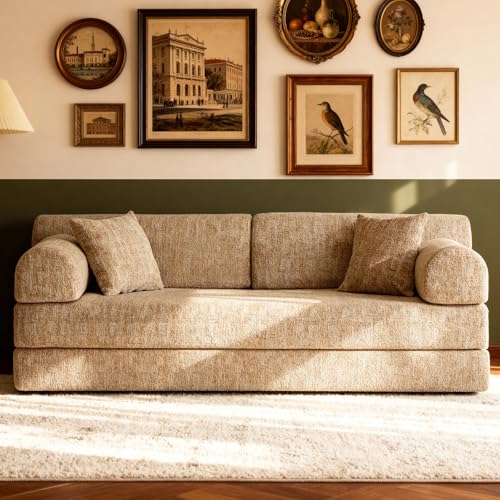
KEIKI 4-in-1 Folding Convertible Sofa Bed, 78" Oversized Loveseat Sleeper with Pull Out Bed, Corduroy Upholstered Boneless Apartment Size Couch for Living Room, Soft Chaise Lounge for Studio, Ochre

Dreamzie 65'' Convertible Sleeper Sofa Bed with Swivel Side Table, Chenille Pull Out Couch for Living Room, Loveseat Sleeper Couch with Hidden Storage Space | Charging Port | Cup Holders, Grey

Serta Ainsley 66.5" Convertible Sleeper Loveseat, Full Size, Dreamcoil Comfort, Soft Woven Fabric, Oyster

108'' Modular Sectional Sleeper Sofa Couches for Living Room, Dark Grey | L/U Shaped Sleeper Sofa, Pull Out Couch Bed, Hidden Storage, Modular Design, Comfy Corduroy, Removable Cover, Movable Ottoman

Ball & Cast 86" Sectional Sleeper Sofa Bed Pull Out Couches for Living Room | L Shaped Convertible Pull Out Sofa Bed with Reversible Storage Chaise and Side Pocket, 3-Seat Sofa for Small Space Apartment

MALOL Convertible Chair-Fabric Sofa Bed, Single Sleeper Sofa, Dark Grey | Small Futon Pull Out Couch Bed with USB Port, Foldable Table, Pillow, Adjustable Backrest for Dorm/Bedroom/College/Livingroom

SUNWAVE 90" Sleeper Sofa, 3-in-1 Pull Out Sofa Bed Corduroy Couch Bed | With USB Ports, Cup Holders, Hidden Storage Armrest & Side Pockets Convertible Sleeper Couch for Living Room, Small Spaces
What to Look For When Buying a Horizontal Sleeper Sofa
Not all horizontal sleeper sofas are built to the same standard. Use this checklist to evaluate quality before you buy.
- Mechanism Smoothness: Test the side-pull or flip-out action. It should glide without binding, scraping, or requiring excessive force. A stiff mechanism often signals poor alignment or cheap rails.
- Frame Material: Hardwood or reinforced metal frames outperform particleboard. If the listing does not specify, assume the worst and check reviews for sagging complaints.
- Cushion Density: High-density foam (2.0 lb/ft³ or higher) resists flattening. Low-density foam may feel comfortable in the showroom but collapse within a year.
- Sleeping Surface Length: Measure from head to foot. Anything under 72 inches is tight for average adults; under 70 inches is only suitable for children or very petite sleepers.
- Mattress Type: Many horizontal models use built-in foam platforms. If you prefer a replaceable mattress, verify that the model accepts a standard sleeper sofa pull-out mattress.
- Upholstery Durability: Look for tight weaves and stain-resistant treatments. A grey sleeper sofa or navy sleeper sofa in a performance fabric hides wear better than light-colored linen.
- Warranty Coverage: A minimum 3-year warranty on the mechanism is a reasonable benchmark. Five years or more indicates manufacturer confidence.
Also review the sleeper sofa buying mistakes guide to avoid common pitfalls such as ignoring door width, underestimating assembly time, or choosing based on aesthetics alone.
Caring for Your Horizontal Sleeper Sofa
Horizontal mechanisms have fewer moving parts than traditional pull-outs, but they still require periodic maintenance to stay smooth. Here is a simple care routine:
- Lubricate the Rails: Apply a silicone-based lubricant to the slide rails every six months. Avoid oil-based products, which attract dust.
- Vacuum the Mechanism: Dust and debris can clog the track. Use a crevice tool attachment monthly.
- Rotate Cushions: Flip and rotate seat cushions every two to three months to distribute wear evenly.
- Address Hinge Squeaks Early: A squeaky hinge often precedes a bigger problem. See the sleeper sofa hinge repair guide for simple fixes.
- Protect from Sunlight: Prolonged UV exposure fades upholstery and can dry out foam. Use sun fade protection strategies if the sofa sits near a window.
- Check Leveling: An uneven floor stresses the mechanism. Follow the sleeper sofa leveling guide to keep the frame square.
If the upholstery becomes worn or outdated, a sleeper sofa reupholstery guide can help you extend the life of a quality frame rather than replacing the entire piece.
Styling a Horizontal Sleeper Sofa in Your Living Room
Because horizontal sleeper sofas are wide and relatively low, they respond well to styling that emphasizes length and visual balance. Consider these approaches:
- Long Console Behind: A narrow console table behind the sofa adds storage and anchors the wide profile without crowding the seating area.
- Symmetric Pillow Arrangement: Use an odd-numbered grouping of sleeper sofa pillows — three or five — to break up the horizontal expanse.
- Layered Textiles: A draped throw and textured cushions add depth. The sleeper sofa textile layering guide covers specific fabric combinations.
- Art Placement: A wide piece of art or a gallery wall above the sofa complements the horizontal lines. See sleeper sofa art placement for layout tips.
- Surface Protection: Use sleeper sofa coasters on side tables and a sleeper sofa catchall tray for remote controls and small items.
For a retro-inspired room, explore retro sleeper sofa styling. For a more layered, collected look, the eclectic sleeper sofa styling guide offers creative direction. A mid-century modern sleeper sofa with a horizontal mechanism is particularly well-suited to clean-lined interiors.
Frequently Asked Questions About Horizontal Sleeper Sofas
Final Thoughts: Is a Horizontal Sleeper Sofa Right for You?
A horizontal sleeper sofa solves a specific problem: how to add a comfortable guest bed without sacrificing the floor space in front of your couch. If your living room is narrow, your layout is tight, or you simply prefer a wider sleeping surface, a horizontal model deserves serious consideration.
Start by measuring your space and identifying the sleeping surface dimensions you need. Then compare mechanisms, frame materials, and cushion quality across several models. Use our sleeper sofa starter hub for a broader overview of the buying process, or explore top 10 sleeper sofas and highest rated sleeper sofas for curated recommendations.
Ready to Find Your Perfect Horizontal Sleeper Sofa?
Browse our recommended models above, or explore more convertible sofa guides to compare options.
Explore All Sleeper Sofa Types →